A true or false, but certainly confusing, story about the Model 51J-5.
Or perhaps trying to put order in the scattered information found
The only "official" info (note quotation marks) about this receiver is that referred to Walter Bratsberg, chief engineer of the project: "three complete and fully operational models were built, one of them was for the US Army, another for the Canadian military, and the third took with him when he left Collins-Canada in 1973". 'The third' would have to be the factory unit, but this doesn't make sense with what I see in CCA's Signal magazine issue 71: a very used receiver (see the shadows on the inside and the heat mark of the original rectifier tube in the picture below), which is 51J-5 unit X2, donated by the Bratsberg family to the Hammond Museum in March 2010. Trying to think logically, if the unit he "took with him" was the factory unit, it should show little use, but since unit X2 shows intensive use, and since there is no evidence that Bratsberg was a Ham, it necessarily comes from the military field, would be very strange if it had seen such intensive use in the factory. Perhaps unit X2 was returned to the factory by the canadian military and left there, only in this case would the story make sense... but reading further down, doubts arise.
After this receiver was bought, I searched for info on the internet and this is what I got:
(Saved the pages, posts are copy/paste, superfluous text and callsigns are removed for clarity and privacy reasons). |
From boatanchors@theporch, Oct 1995.
→ A typo in a number gives rise to the subject. |
Comments on the post |
Subject: 75A4 Prices, I'm Walkin'
Someone please quantify for me the benefits of a 75A4 over a 51J5. Thanks and happy walkin" Tom. |
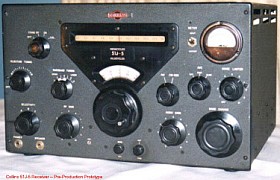
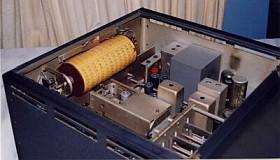
This post refers to the 3 pics appeared on
www.collinsra.com (site does not exist now). Pics above are two of these pics.
Both pics are from unit X2; the unit that was later donated to the Fred Hammond Museum in 2010. This unit has '51J-5' stamped on the dial frame, which is unusual on 51Js. |
Subject: OOPS, that would be 51J4
Substitute "51J4" for "51J5" in my previous poost, err, post. tom |
Subject: Collins 51J-5
I made a boo-boo in a previous post and accidentally typed 51J-5 where I intended to type 51J-4. Shaun Merrigan mentioned that he was sorry to hear that that was a typo as he wanted a 51J-5 to chase.
Well, actually there is a 51J-5 (at least one). I've seen pics of it. It is s.n. X002 and is described (the pic that is) as follows . . . Looks mostly like a 51J-4. Controls on the left are: on/off switch with OFF/STANDBY/ON/CAL, Rejection tunning, Passband Tuning UPPER/LOWER, Selectivity A/B/C, RF Gain Phones and Speaker jacks on the bottom left. The main tuning looks like the regular 51J, but has a big reduction knob. Controls on the right are: METER Input/Output, AM/CW-SSB, AVC OFF/FAST/SLOW, Noise Limiter, Audio Gain, Band Change (just like 51J) Bottom middle controls are: CAL Zero Dial, Ant Tune. This rig was probably interrupted by the 51S-1.
Well Shaun, start looking for one!! |
From www.listserve.com, Mar 2001.
→ The same reason, a digit typo, gives rise to the subject. |
Comments on the post |
Subject: {Collins} 51J5 Problem
Hi all
Some time ago .... blah, blah ... I know the repros are available
Many thanks |
|
Subject: {Collins} 51J5 - Not!
I have had not a few prepared to outlay some quite unreasonable bux for my 51J5. The only thing wrong with that plan is that my senile old fingers developed a life of their own and hit the 5 key instead of the 51J4 key and I actually have a very average 51J4. Such is life in the fast Collins lane and I will die a pauper as I always knew I would.
I did however, learn that there are only two known prototypes of the 51J5.
And that seems like an interesting part of history. Perhaps someone would
like to carry on the thread. 73 Lee |
X1 and X2 units? |
Subject: {Collins} Re: 51J5 - Not!
At 06:47 PM 3/30/01 +1200, you wrote:
>I have had not a few prepared to outlay some quite unreasonable bux for my 51J5.
>I did however, learn that there are only two known prototypes of the 51J5.
Well..there used to be three.. my uncle had the actual first production model and after he died his wife "got rid of all that old junk" without saying a thing to me.. oh well..... Roy |
X1 unit? or factory prototype unit? |
Subject: {Collins} Re: 51J5 - Not!
I had a "J5" and it had no serial number and basically it was an R-388 with
the A4 SSB controls incorporated into it. There were no markings at all on
the dial assembly. Tube layout was quite a bit different and the circuitry
was different- and no schematics. It was in fair condition, and the story was
it was a factory tester which was discarded after years of sitting around. I
was told the prototype for the smaller, more compact 51s1 plans were designed
and the plans for the larger radio production were scrapped in favor of the
newer S line. Sold it at the HOSTRADERS flea market 9 years ago, so somebody
has it.
Years ago Bob Grinnel had serial #2 along with the blueprints, and
advertised it for sale around 10-15 K mark. My thought was to get a copy of
the diagram, but my plans never materialized due to losing my job. This was
11 years ago. I'll bet Bob kept a copy though....
There was a J5 in New York that was identical to mine for sale some years back. I dare say it is out there somewhere..... Bruce |
X0 unit? Presumably the factory test unit.
X2 unit for sale at Surplus Sales of Nebraska? This is contradictory with the info provided by the engineer and what I know.
The alleged X1 unit referred to above? Land Air Communications of Harold Guretzky? |
Subject: {Collins} Re: 51J-5
Hi Lee and All:
The 51J-5 was developed at the Collins-Canada plant in Toronto in 1957/58 as
a General Coverage version of the 75A-4. (ie. no SSB on the J-4)
Walter Bratsberg, the project engineer said that 3 engineering models were
produced. It was superseded by the 51S-1 in '59 and never went into full
production. He has one and it has "51J-5" on the escutcheon. See photo in
Issue 15 of "The Signal CCA" (the quarterly newsletter of the Collins Collectors
Association). Of the other two built, one went to the US Navy and one (he thought)
to the Canadian military.
Cheers, Peter |
This post refers to the "official" info on 51J-5.
Info in issue 15 was later expanded in issue 71.
The one "he has" shows 51J-5 in the escutcheon, it is unit X2, the unit that was donated by Bratsberg to the museum. Since X2 is very used, it is a military unit for sure. Same for unit X1, so the units for the military are X1 and X2, and these are "the other two built". That sentence has an internal inconsistency considering the evidence shown by units X1 and X2 ("the other" is contained within "he has"). Bratsberg then donated to the museum the unit used by the Canadian military, not the factory unit. |
 |
And now the cherry on top: 
The unit I have is X1, which was previously owned by a wealthy Ham who was also a collector. The Ham selling his estate told me he bought the
radio at Surplus Sales of Nebraska, that collector was a regular SSoN customer (inside the radio there was an SSoN ad with a 51J-5 for sale). According to posts above, were X1 and X2 units sold on SSoN? If it is true, the engineer bought the unit which is in the Fred Hammond museum in SSoN, and this means he didn't take the radio with him... is anyone able to understand this mess?
IMO, people are probably confused on serial numbers and 51J-4 models (it had variants), and memories are reformulated over time. That the engineer took "the third" 51J-5 with him is not entirely clear due it is unit X2. Both the X2 and X1 units show intensive use, a factory prototype unit should look much less used, and these units are typically less finished as well. The info based on Bratsberg words only makes sense if the X2 unit was returned to the factory by the Canadian military -to repair and it was left there?-, and of course this would mean that X2 is "the Canadian unit".
I speak of ‘units’ rather than ‘models’ because as far as I can see, units X1 and X2 are identical circuit-wise, therefore model is unique and has two productions. Most likely the factory test prototype was not even numbered (or was X0), and when Collins moved Bermondsey for Bartley Drive in 1963 was stored elsewhere or "cleared" along with similar material to scrap dealers. |
Conclusion:
|
|