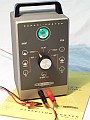
| The Heathkit IT-22 Capacitor Tester is
an instrument that allows the user to check capacitors without removing
them from the circuit or, of course, removed from the circuit. It will
disclose open, shorted, or intermittent capacitors and, with just a little
bit experience, permits evaluation of possible leakage. This is an
easy-to-use tool for taking a look inside vintage equipment;
a quick-&-dirty tool for performing in/out-circuit tests of old
paper capacitors which are commonly found on 40's, 50's, 60's tube gear.
The IT-22 is the CT-1 successor (same instrument with different appearance). |
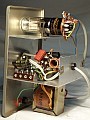
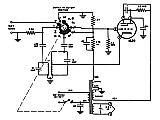
Pics & schematic + info pages
 |
 |
 |
 |
 |
 |
Using the IT-22.
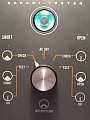
A five-position switch is employed. Center is "AC OFF". At left is "AC
ON - CHECK" for "SHORT" with its "TEST" position and at right are the same
positions for the "OPEN" test. The switch is spring loaded in the "TEST"
position so as soon as you let go it springs back to return to the "CHECK"
position. This switch action removes any voltage stored across the capacitor
during the test. The operation of the IT-22 is simple but sometimes confusing
because when the eye tube closes or remains closed, the test is "OK", but
it reflects a negative condition (NO SHORT circuit, NO OPEN circuit).
Before testing, however, make sure the power is off in the equipment
being tested.
Switch to "OPEN CHECK" or "SHORT CHECK" position (choose whichever test
you want to put in operation first) and allow the instrument time to warm
up. Clip the test leads across the capacitor to be checked, then switch
to "TEST" position. An OPEN eye in this position always indicates a BAD
capacitor, and a fluttering eye always indicates an intermittent capacitor.
If the eye CLOSES (or remains closed), then MAKE the OTHER TEST.
It should also be remembered the following...
-
On IN-CIRCUIT testings may occur false results due stray capacities or
if the capacitor to be tested is not sufficiently isolated from its associated
components.
-
Open eye in the "TEST" position always indicates a BAD capacitor.
-
ELECTROLYTIC capacitors can only be checked for "OPEN" (for "SHORT" they
all will be considered shorted).
-
A SHORTED capacitor tested for "OPEN" will always result "OK" (not open).
-
An OPEN capacitor tested for "SHORT" will always result "OK" (not shorted).
-
Therefore, when the first result is "OK", it is mandatory to make the other
test.
|
Specifications and Operation
| SHORT test |
Heathkit says "up to 20 µF
shunted by at least 10 ohms", but only an equivalent resistance greater
than 1000 ohms closes acceptably the eye (not shorted indication = OK).
-All tipes EXCEPT ELECTROLYTICS.
-Test frecuency: 50-60 cycles (AC line).
-Test voltage: about 17 volts AC. |
-Switch to the left (CHECK-ON).
-Clip the test leads across the capacitor to be checked.
-Switch to "TEST" position.
-Open eye indicates a SHORTED capacitor.
-Totally closed eye indicates a "NOT SHORTED" capacitor but it may
to be open.
-Partially closed eye indicates a possible LEAKY capacitor *1.
-Fluttering indicates intermittency. |
| OPEN test |
Specs: "50 pF to infinity shunted by more
than:
2000 ohm at 50 pF.
400 ohm at 100 pF.
30 ohm at 350 pF or more."
But only an equivalent resistance less than 10 ohms or a capacitance
greater than 30 pF closes totally the eye (not open indication = OK).
-All tipes of capacitors.
-Test frecuency: 19 Mcs (HF oscillator).
-Test voltage: Very low (RF current). |
-Switch to the right (CHECK-ON).
-Clip the test leads across the capacitor to be tested. Red binding
post is + (for electrolytics only).
-Switch to "TEST" position.
-Open eye indicates an OPEN capacitor.
-Totally closed eye indicates a "NOT OPEN" capacitor but may to
be shorted or leaky.
-Fluttering indicates intermittency. |
| *1 This instrument will not check accurately
capacitors which are shunted by an inductance if the reactance of the inductance
is less than about 30 ohm at the test frecuency (50-60 Hz for the short
test, 19 Mhz for the open test). In the "SHORT" test, a partially closed
eye may indicate a possible leaky capacitor BUT considering that low reactance
at test frecuency (50-60 Hz) of the circuit involved will result in erroneus
indications. The existence or importance of the leakage must be confirmed
disconnecting one lead and using a condenser checker, like the C-3. |
Tricks & Mods
Tech Notes:
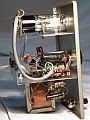
2M2 res (R3) between pins 3 & 4 (plates) determines the level
of closure/aperture of the eye tube. If the value is too low, the eye will
not open fully and it could strongly overlap when closed. The exact value
of this resistor must be adjusted in the "OPEN-CHECK" position: lowering
it will increase the eye closure, raising it will increase the eye aperture.
The correct adjust is getting the eye near-closed (making an hairline). This adjust, if neccessary, must be accomplished
first.
1K5 res (R2) determines the level of closure for SHORT testings.
An increased value of this resistor increases the closure of the eye tube,
and conversely. Choose a value for getting the eye near-closed (making
an hairline) in the "SHORT TEST" position. This adjust must be accomplished
after the mentioned above.
Usual TLC:
- In order to maintain an adequate level of closure/aperture in the
eye tube, the 1K5 resistor commented above may be replaced to compensate
tube aging. Before doing this, it is recommended to verify possible replacement
of R3 by the same reason.
- Cleaning, of course.
|

|
