The electro-mechanical issue due bad pressure contact in open-construction IF tuning capacitors already explained (link at bottom left) may be confused with a chemical behavior. The so-called Silver Mica Disease (SMD) is in fact an inherent property of silver: the blackening process. Silver does not react to the oxygen contained in the air, but it is slightly vulnerable to the slight concentration of hydrogen sulfide (H2S) and carbonyl sulfide (OCS) that also exists in the air. Contact of silver with sulfur causes a reaction known as sulfidation, which in the long term tarnishes the metal, and silver turns black. If sulfidation is conductive enough, may cause major problems if it expands (migrates) around.
The greatest cause of failure in an open-construction silver mica capacitor is bad environmental conditions combined with aging. Humidity degrades coating, the silver becomes tarnished, a degraded connection produces heating, and surface contacts result damaged. In a more advanced phase the oxidized silver area spreads this tarnish across the mica insulating space creating a conductive pathway between silver layers or another alternative leakage pathways. The amount of oxidation increases with the amount of time the current has flowed over the silver-treated mica surface. The only solution is to replace this open-type capacitor by an standard one of same capacity. The photos below show the process of replacing these "designer"
capacitors with standard capacitors, much safer ones. Due the low
frequencies involved and existing shielding it is not necessary
to use NPO or similar capacitors, also it is unnecessary to believe
that this problem exists by default, so I don't recommend starting
to make unnecessary "improvements" that tend to spoil the original design.
The same applies about believing electrolytic capacitors of the
power supply are damaged, what must be done is checking 'em, not replacing
'em by default.
Usually this short is located in the middle of the high-IF tuning capacitor (LC next to mixer tube plate, Tx and Tx+1 inter-link lugs are located at center and under the tuning capacitor), if isolation fails the leakage current burns capacitor and resistor. It is a classic Hammarlunds' illness, but do not assume that the same thing happens to all Hammarlunds. Schematic above right (HQ-170) shows the classic Hammarlund mixer/converter design. Pictures below show the repair process of the dual frequency transformer installed in the mixer plate load line. These transformers are labeled 'T1' in HQ-160, HQ-110, and 170 models, but labeled 'T5' in the HQ-145 model; mostly manufactured by Artted Co. Inc. The most common evidence is to see the plate line decoupling network resistor
very "toasted" (see below), this always indicates a serious fault in the transformer.
The most popular belief is that silver migration causes a dead short that destroys
the tuning capacitor, but the example below shows that the short-circuit may
be not due to silver expansion (migration, as per pic above).
As it is an open construction built-in capacitor (unsealed) any "product"
that constitutes a path to ground may create the problem.
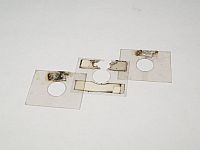
The blackened silver areas are the ones that were in contact with the air:
the edges. Silver migration is minimal, the real cause of the short circuit may
be due insufficient insulation, formation of conductive dirt, or another
type of crossing path to ground, thus the Silver Mica Disease is not just a
"disease" of silver mica, but also and rather a insulation problem.
Hammarlund combined mixer RF transformer repair (Artted Co. Inc.)
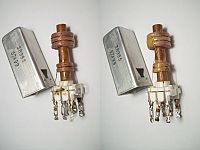 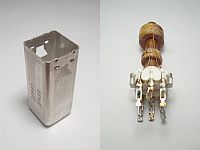 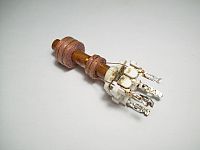 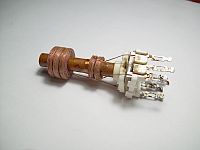 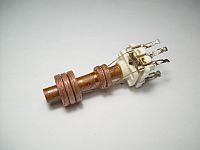 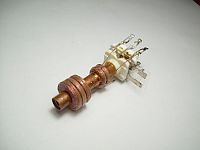  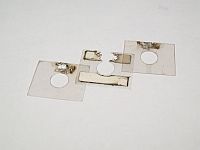 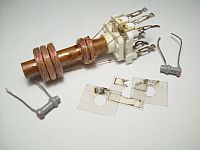 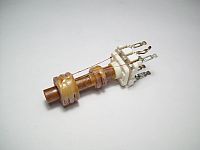 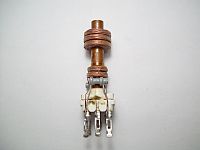 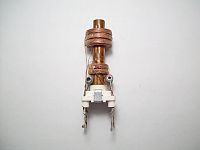 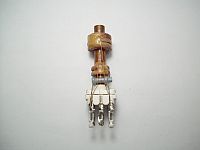 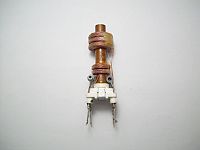 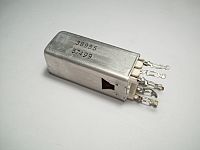 The same process can be carried out inside the T2 grid transformer, but T2 does not have B+ passing trough, so it will only cause loss of sensitivity or erratic noise, not a serious fault. A failure in T2 can be detected by adjusting the slug, immediate response means T2 is fine, but no response means defective associated capacity, and the same if the response peak is reached at a quite different slug position (this means that the lack of capacitance can be adjusted by increasing the inductance). The problem is not the silver mica, the problem is lousy design made worse when there is DC overvoltage associated with weak insulation and possible paths to ground.
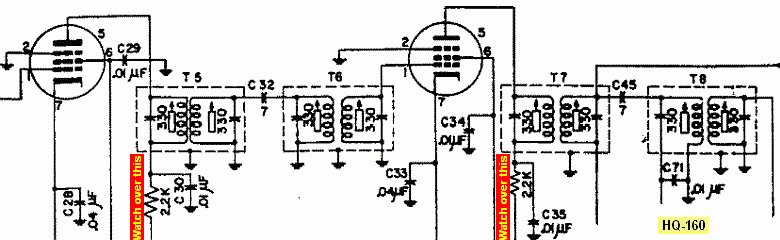
SMD in IF transformers: The Hammarlund receivers cited above (and most likely other models from the gray HQ line) are equipped with Automatic Mfg Co IF transformers which also have tuning-capacitor open-construction design, so the same process can be carried out inside these transformers. Those transformers are part of an standard layout of a high-Q IF chain like the one below:
Again, the most common evidence is to see the plate line decoupling network resistor very "toasted" (those marked in red above, see pic below). See below for a repair method for those transformers; it only requires a short file, a piece of wood, a small cutting plier, and 4 pieces of short, thin wire, to make locking washers for the terminals. Due to the structural layout of the IF transformer (patented by Automatic Mfg. Co.), the repair process is a little more complex than the previous one.
Hammarlund gray HQ line IF transformers repair (Automatic Mfg. Co.)
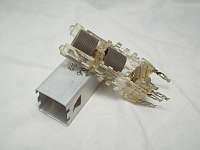 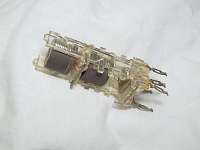 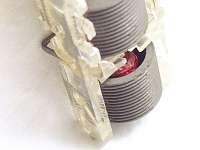 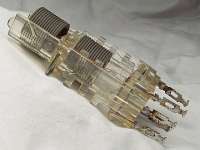 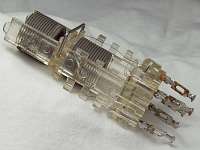 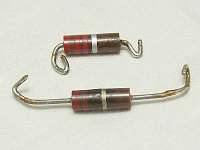 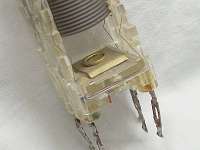 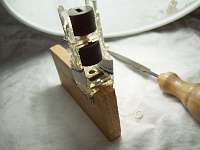 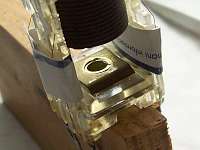 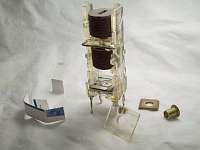 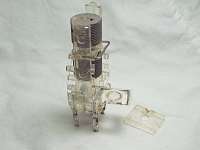 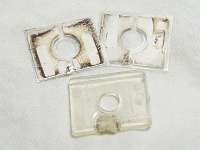 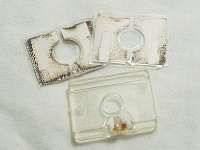 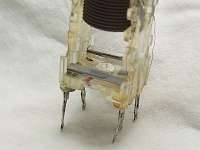 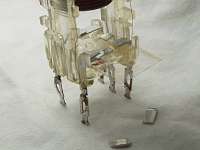 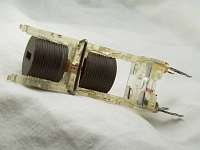 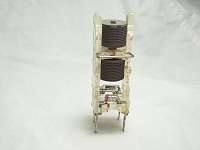 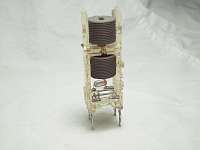 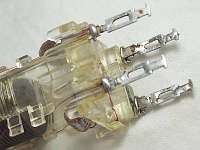 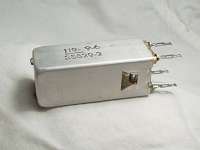 The same process can be carried out in the secondary (output/grid tuning), but the grid circuit does not have B+ passing trough, so it will only cause loss of sensitivity or erratic noise, not a serious fault. A latent flaw can be detected by adjusting the secondary slug (which is usually the top slug in Hammarlunds); immediate response means correct working condition, no response means faulty coupling.
This "disease" develops as follows:
Also, since these capacitors have an open-construction design, insulation failure can occur at any time. So be careful about some harsh cleaning procedures applied to old gear because, instead of cleaning, they can drive dirt inside some components. So, the conclusion about the design of placing open-construction, silver mica capacitors, at the bottom of IF transformers, combining them with transformer coil connections, thus allowing to create combo lugs, is that it was "modern" and "advanced" in those days, but not a quality design in the long run.
|
 The SMD issue usually develops when a receiver that has this type of open-build
capacitors has been stored for years in a humid environment; this can easily happen
because a lot of old tube radio sets have been sitting in someone's basement for who knows how long.
The SMD issue usually develops when a receiver that has this type of open-build
capacitors has been stored for years in a humid environment; this can easily happen
because a lot of old tube radio sets have been sitting in someone's basement for who knows how long.
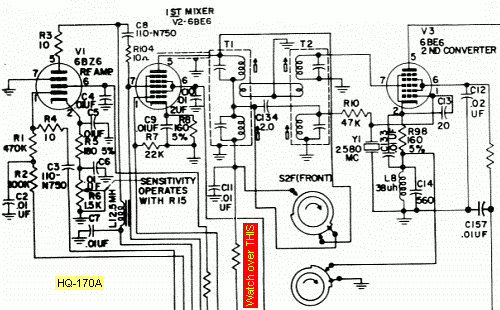 SMD in RF transformers: On quite a few Hammarlund HQ gray line models, mainly HQ-110 (s/n 5000+), 145, 160, and 170 (classic conversion scheme on the right), the B+ line resistor is in series with the primary of the RF transformer, which is part of the decoupling network that provides voltage to plate of the first mixer (R44 in model HQ-110, R12 in HQ-160, R7 in HQ-145, R9 in HQ-170), may result burned due a B+ path with the chassis, but a similar issue may occur in any receiver that use transformers with open-construction type silver mica capacitors.